
Matt Bunn - Sustainability at Nottingham College
Interview with Matt Bunn, written by Andy Barrett
Matt Bunn is the sustainability lead for Nottingham College which has just won the Sustainability Institution of the Year at the Green Gown Awards. We sat down at their City Hub campus on Canal Street to talk about the impressive work that has been taking place there over the last few years.
Could you start by telling me how you became involved in this role?
I was a professional sports photographer when I started as a lecturer here in the media department, but as time went on I began to realise that I wasn’t enjoying sitting outside in the cold weather very much anymore and so I gave that up during COVID. During that time, like many people, I found myself traveling less and becoming more involved locally. I started to wonder how I could engage the students I was teaching in the kinds of questions I was wondering about, questions prompted in part by my own children’s concerns about climate change.
I came up with the idea of holding symposiums in the college to explore how students understood the challenges, and to hear their ideas around the environment. The new CEO Janet Smith was really supportive of this and offered me a job as the lead for sustainability across all of our sites. I’ve been in post now for nearly three years, teaching photography two days a week and doing my sustainability work for three days. It’s been growing year on year and the support from the senior team has been great. I'm really lucky that I have a good budget and autonomy; I don't have to go and ask every time I want to do something. There’s trust in what I am trying to do.
On the college sustainability homepage, which pledges ‘Becoming Carbon Net Zero, for Type 1 & 2 (direct) emissions by 2030’ it says ‘we have a duty to raise environmental awareness amongst our staff and learners’. Can say a little bit more about that?
That’s something I really believe in. We've got around seventeen hundred members of staff and twenty thousand students, so we're a massive part of the city. We teach all sorts; business, media, dentistry, and I think that if we weren’t teaching our students how to do all of these in a sustainable way that we wouldn't be doing our job. Which means that our educators have to be on board with that idea, that imperative. We know it’s difficult because teachers in FE and HE have a lot to do, but over half of the staff are involved in professional services rather than running the curriculum. It can be more apparent in those departments where sustainability can be improved, through procurement and the way that things are run.
In terms of the curriculum staff we’re using a carbon literacy training tool that has been created by Manchester Metropolitan University and Nottingham Trent University as our main starting point. There are currently ten of us who deliver that four-hour training course although we’re hoping that as time goes on more people will be able to run them. To be honest the take-up has been quite poor partly because staff are really busy, and so we’re making it mandatory for the leadership teams that sit above teachers, and there are a few hundred of them over the six or seven sites that the college operates.
My hope is that when staff members are confronted with the information, they will go away and let it percolate. It’s not a case of forcing people to do things, which never works, but hopefully to engage them in thinking about how they are going to use that knowledge. Maybe it will impact how some of them start to live their own lives, and that is when things naturally feed down into how they approach teaching their subjects. We’re also planning to start offering this training to our students as well.
(You can find out more about the Carbon Literacy Project, which aims to develop ‘awareness of the carbon costs and impacts of everyday activities, and the ability and motivation to reduce emissions, on an individual, community and organisational basis’ here).
Then we have sustainability days where we have guest lectures and organisations will come in, like Sustrans who will offer personal travel plans for people. We have Nottingham Bikeworks, people who come and teach you how to fix your clothes, Nottingham Organic Gardeners, Nottinghamshire Wildlife Trust. It’s about practical advice and also about how we reconnect to nature in a world where everything is being digitized.
In your Carbon Management Plan I see that you started this work by gathering college views on sustainability from staff and students. What kind of ideas did the students come up with?
I don't mean this in a patronising sense but students and staff who are uneducated about this immediately talk about recycling, because that's what we've been sold as the answer. Printing and plastic came up and we have reduced our printing by 50% and have just put a cap on what staff and students can print. We’ve started to address the issue of single-use plastic which is actually unbelievably difficult to tackle. Food also came up.
I know that we have a definitive aim around carbon but I also know that nothing's going to happen overnight, however quickly we need things to move. There’s an understanding now that the tipping point for social change is around 25%, that’s the magic number at which real change begins to happen at speed. This is why you have to build from the bottom up, with staff and students. When we're looking at our training, we're looking at firstly involving those people who want to do it, who want to get the message out. That may sound manipulative but that's the strategy.
Are you aware of a developing climate anxiety amongst your students or have they been inundated with so much news and concern around this, as well as a lack of action, for so much of their lives that it's just become noise?
I think we are entering that situation in general. If you look at COP30 it's hardly on the news, no-one's really interested. So how do you change that? When you look at Extinction Rebellion it’s clear that their actions have annoyed a lot of people. And people don’t like change, or are too busy to really deal with the effort of making change in their own lives. What we need are psychologists on board who will teach us how to teach.
There are lots of kids who do want to talk about it and have changed aspects of their lives. None of my students bring in plastic bottles because I've just harangued them so much. But I am surprised how little time is spent confronting this challenge within the wider education system. My youngest has just finished at school and when I asked him what he was learning around ideas of sustainability he said ‘nothing’. I phoned up his Head of Year, who is lovely, and asked him about it and he said they just haven't got the time to have those kinds of conversations.
So how do you incorporate sustainability into the curriculum?
In terms of my own subject, I create projects for students which allow them to have conversations around these questions and ideas. (Here is a good example of a recent photography project by college students engaging with ideas of consumption). As a college we are guided by Ofsted and there are so many things that you need to concentrate on, so you have to be creative in creating the space for this kind of thinking and engagement.
Every full-time student also has what are called PSD sessions for one hour a week, which are run in ten-hour blocks and look at issues such as sex education, drug use, online use, and sustainability is one of those blocks. Obviously, like everything, it comes down to how that is delivered but if it’s done properly you can do some great stuff within that time.
We’ve also come up with a project called Sustainable Futures, which is available for all of the students. That started when one of my colleagues who was teaching Business asked students to place in order those things that they thought were important to that subject and climate change came bottom. So, he devised this idea where they had to pitch an idea that addressed that issue in some way. They could create a business, a PR stunt or engage in something that's happening within their local community. The winner was a group who highlighted how much plastic we used as a college by building a structure, that sat outside this building for a week, that they filled with something like 4,000 plastic bottles; which was what we used at the college every two weeks.
That idea has grown and so now we have a £4000 prize, which might be won by one group, or one person, or spread out across several winners. It’s extra-curricular but is pushed right across the curriculum to encourage involvement. They come up with an idea which they have to pitch to a series of panels, we shortlist ten ideas and then they have ten weeks to develop these with mentorship that we provide. Then they have to take part in another panel with me, the Deputy CEO and the Chief Financial Officer; and this year we’ve got the MP Lilian Greenwood and the Mayor of the East Midlands Claire Ward sitting with us. So it's really aspirational and challenging for the students.
Last year there were 100 projects put forward and a lot of them were impractical or very small scale but there were a few gems in there (including Overconsouption). There was one that didn’t win but we're installing it at our Hair and Beauty salon where members of the public can bring in their own bottles to refill the shampoo or whatever else they get from there. Again, it's about creating a space for those conversations just by having that station in the salon. So, this project has become a really important part of our sustainability work and we have lots of resources online to help the students with their thinking and planning.
You can find out more about some of the winning ideas here.
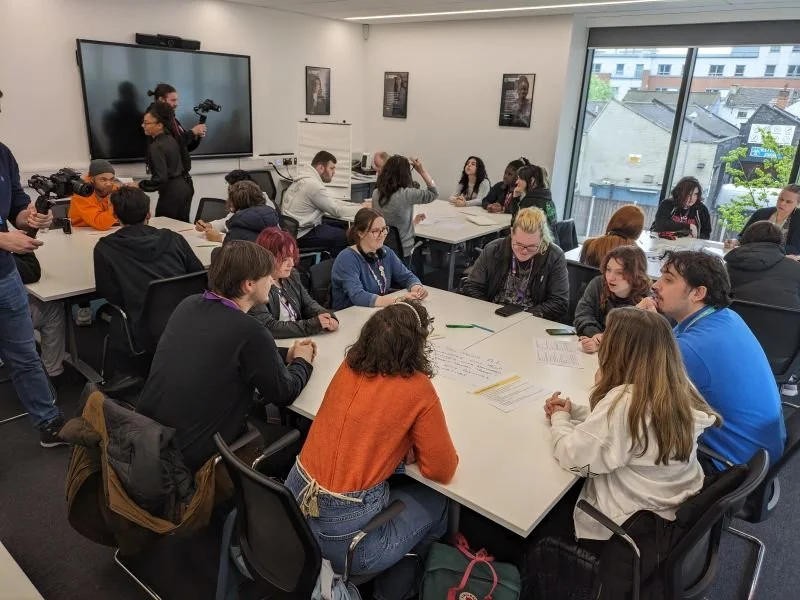
We also have a College Sustainability Group and as part of that are about to launch a project called Sustainability Champions which again is about making links between the college and the local community, and providing students with the opportunity to work on project ideas and meet others who share their concerns and who want to explore ways to take action and get involved.
Earlier you mentioned the idea of rebuilding our connection with nature and I wonder if you could say more on that. When people talk about the changing climate and the kinds of actions that need to be taken, so much of the conversation is around figures and graphs and temperatures rather than being engaged and connected to the non-human, non-abstract world.
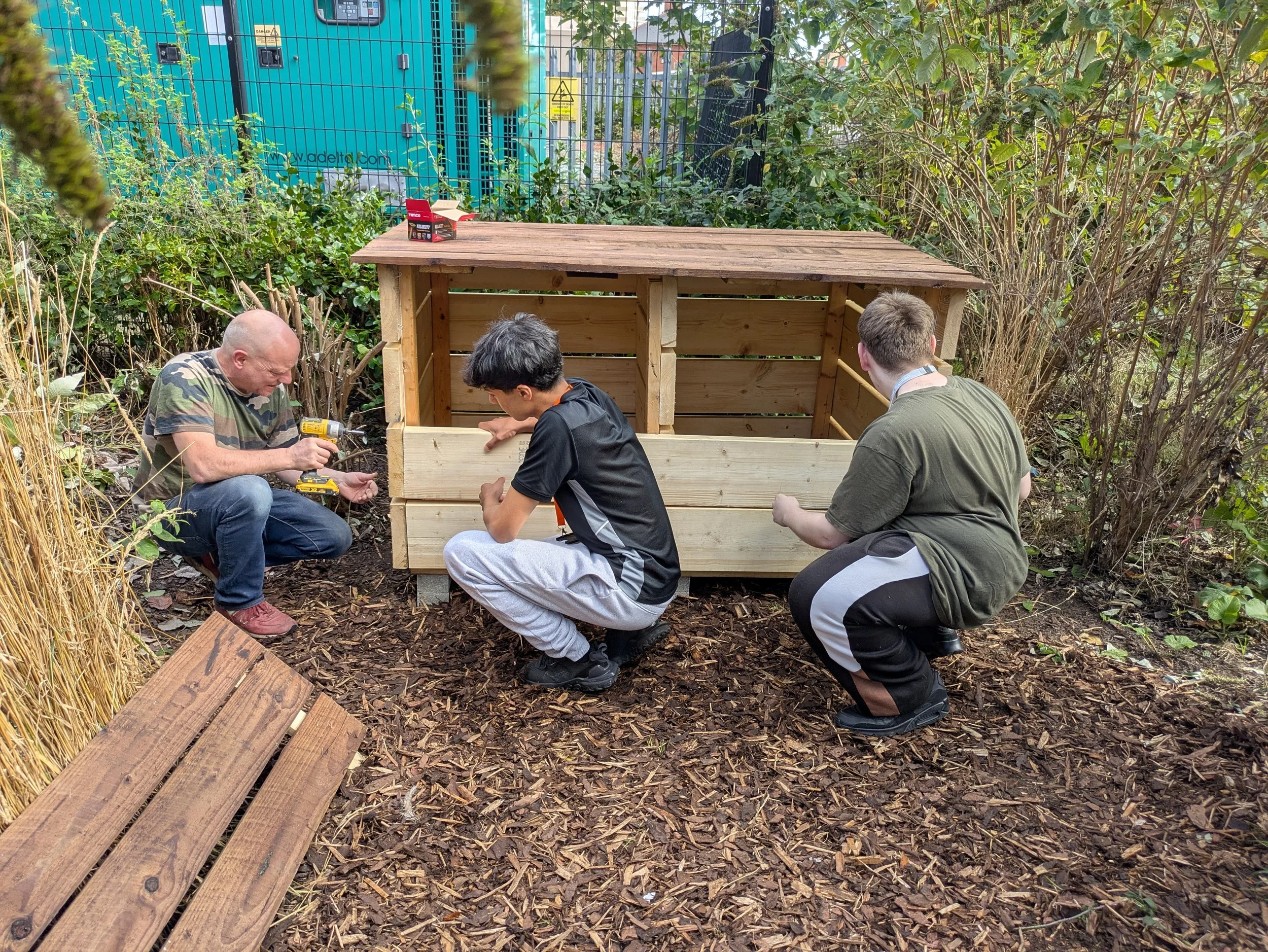
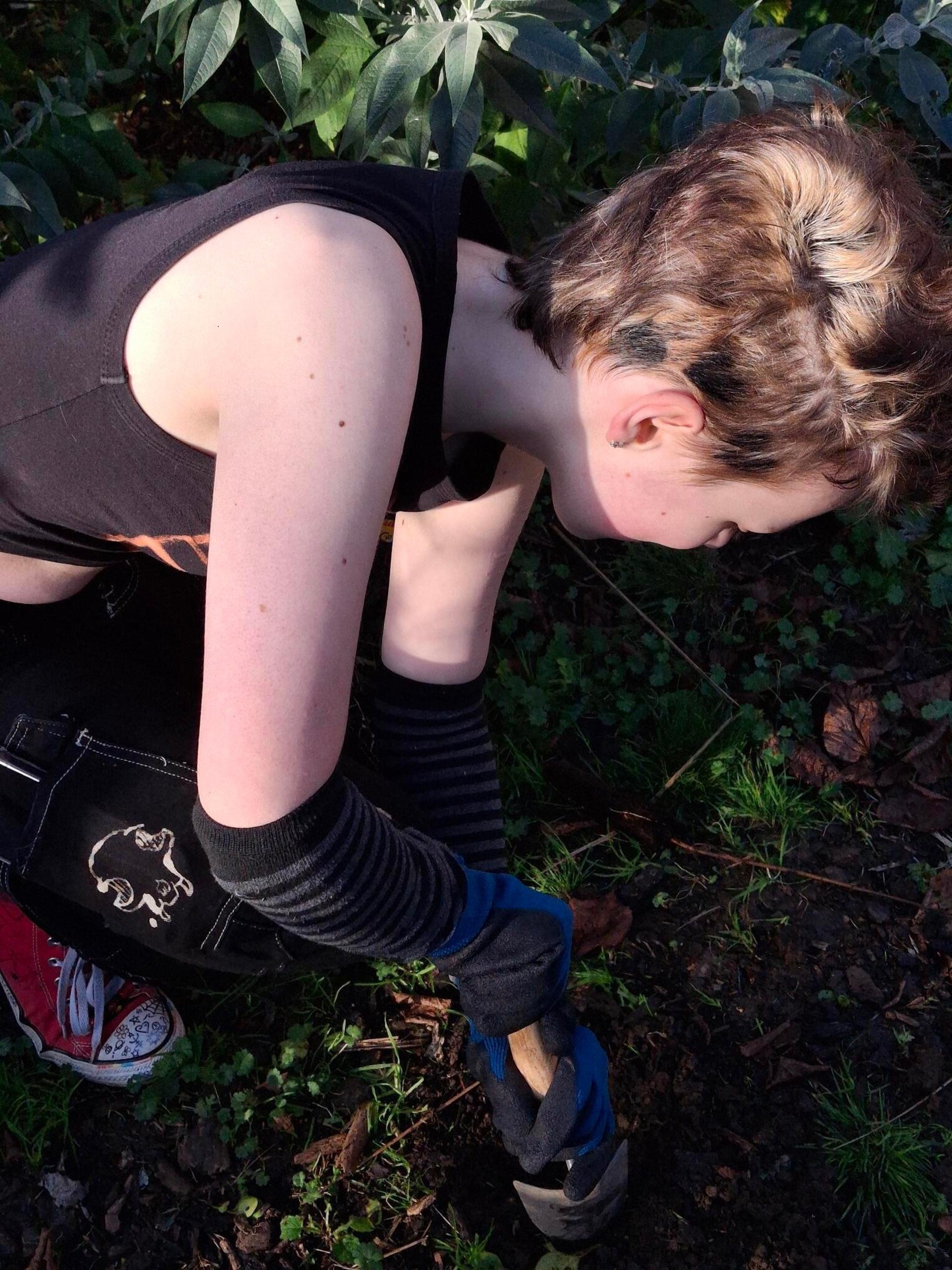
We recently received some funding from SOS (Students Organising for Sustainability) through a ‘Wilding Campuses’ project which allowed us to employ a biodiversity manager, called Liz Morley, who has been absolutely phenomenal. She’s planted a Miyawaki forest at the back of this campus as part of planting 700 trees and making gardens across our sites. We’re making a bigger allotment out there that feeds into our Fletcher's restaurant, and Liz is also putting in a pond at the Basford campus. It’s more difficult to do work like this in, say, the Adams Building, but we are really increasing biodiversity. It’s remarkable what Liz has done in under 18 months; she’s teaching students, she's working with students who don't have gardens, who don't have access to the outside. She'll put up a post up saying ‘come and help with planting these trees or digging a pond’ and they come along to join her.
When I first started thinking about sustainability it was all about how we can lower our carbon emissions. But withing the first year I saw that if we do other things properly, that this will happen, which brought me back to thinking to the engagement with the local that I had during COVID. As I mentioned we have the Notts Wildlife Trust and GrowNotts and others coming here to try and encourage our students to get outside.
But you can’t just expect the change to happen overnight with teenage students. Give them the information and the opportunities and then just let it go. Hopefully when they leave us, they'll meet other people and they will start to take action and pass on their knowledge and things will just organically grow. That's my hope.
How are the aspirations around zero carbon going? I see that the website says ‘Since our baseline year 2019/20 we have reduced our carbon emissions by 45%, some 1448 tonnes.’
It’s a real challenge and to be honest we've taken all the low-hanging fruit, although there is always more we can do. But a lot of the major work, which is focussing on the generating of our own power, is really under the auspices of the Director of Estates. We have put photovoltaic panels on Stoney Street and we’d like to get them here. But one of the issues we face is the kind of buildings that we have. We’ve changed all of our heating over at the Adams building but it’s a Grade Two property which makes it difficult to do the kind of structural alterations which can help with insulation and energy wastage. That’s a real challenge going forwards more generally; how you have listed buildings that aren’t going to be usable unless there is more flexibility by those organisations that are safeguarding these buildings around how they can be adapted.
How does your work connect with the city-wide educational environment and beyond?
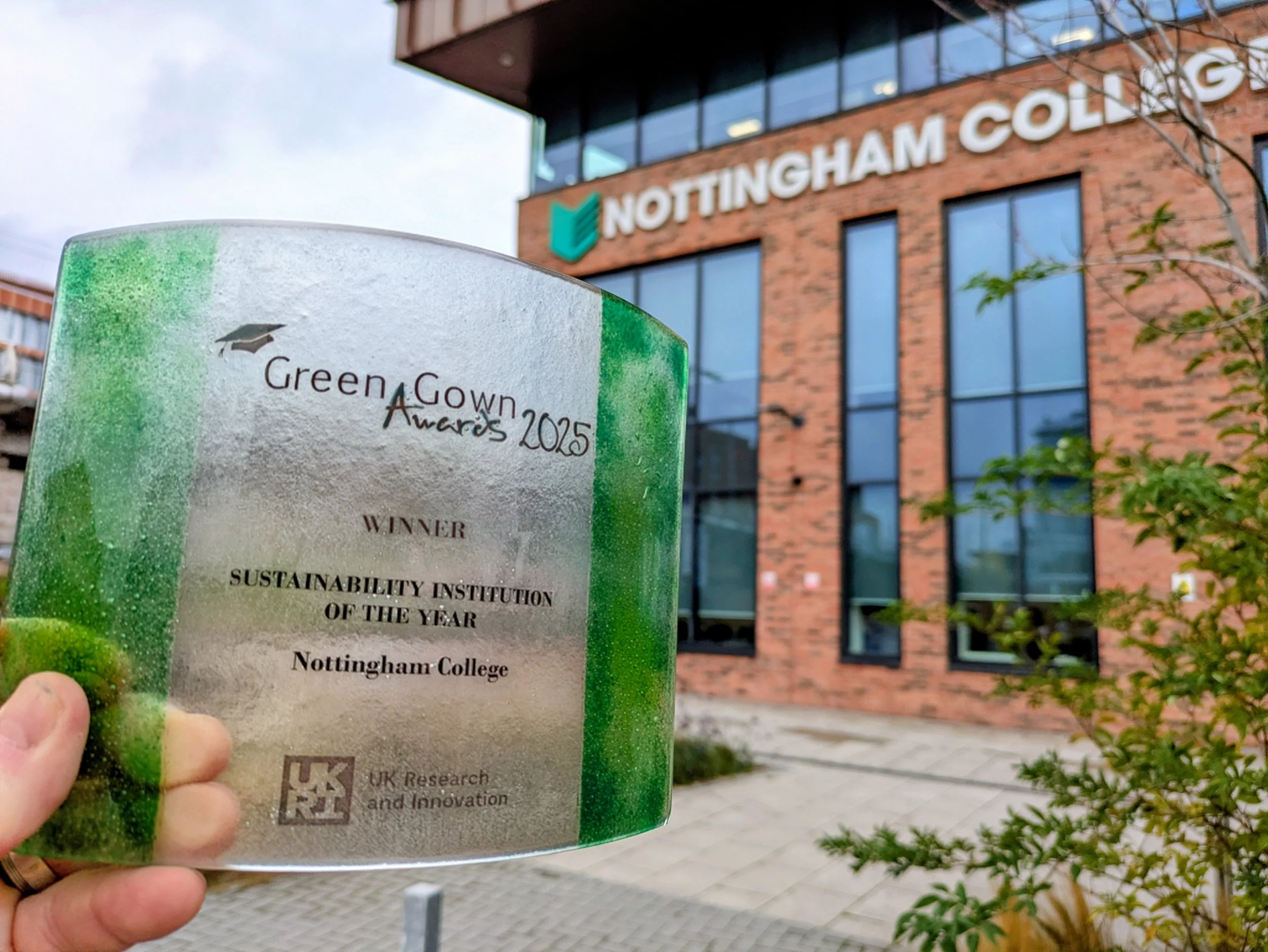
We work fairly closely through the green partnerships we have with the two universities both of whom take sustainability really seriously. Now that we’ve won the Sustainability Institution of the Year at the Green Gown Awards, I imagine that people will take a little more notice of what we’re trying to do when we're recruiting students, when we're recruiting staff, and where that positions us in the city.
What are the Green Gowns?
They’re run by an organisation called the EAUC, the Environmental Association for Universities and Colleges (‘the leading body for sustainability in the post-16 education sector in the UK and Republic of Ireland’) and for the past 21 years they have been running this award scheme to recognise innovation and leadership in sustainability. They’re seen as being very prestigious and the process you have to go through to be considered for an award is really rigorous. The EAUC carried out a sustainability audit on the college last year and we were clearly doing well so we thought we’d give it a go and jump in at the deep end and just go for institution of the year (there are around 20 different categories).
That was a real challenge because we’re up against universities and colleges across the whole nation, but it also meant we had to collate everything that we had done an achieved, which was really helpful. I found out on my birthday that we’d been shortlisted which felt like a win in itself, and when we went to the ceremony at Birmingham and were named Institution of the Year it was phenomenal; I nearly cried! But of course, now the imposter syndrome starts to creep up on you and you think, we have to prove that we’re worthy of this and there’s so much still to do.
‘The judges were impressed by Nottingham College’s commitment to reaching net zero by 2030, underpinned by a bold approach to removing fossil fuels from its buildings, embedding sustainability throughout the institution and having an impact on its local community. The college was particularly commended for making a difference in a disadvantaged area, having consciously focussed on sustainability initiatives that improve lives’. (EAUC – for a full list of winners look here).
What is happening around sustainability at the college right now?
We’ve just had a meeting here to talk about next year’s Nottingham Climate Assembly, which was really lovely to host. We’re holding our own conference here in June, as part of our aim to be a conduit for people and organisations in the city to come together. We’re working hard to stick to our sustainability strategy and ultimately, as educators, we know that we need to provide the young people that come here with the skills that they need. Green skills are clearly an important part of a changing economy, you just need to look at the thousands and thousands of houses that need retrofitting. We absolutely want to be at the forefront of that and the college is soon to open a new Engineering and Electrical Centre at the Ruddington campus which is all about teaching those skills that industry is demanding around sustainability and renewable energy.
I continue to go round the different campus sites, and am looking at food at the moment which is a real issue. We run a Meat Free Monday once or twice a year and sales go down by something like 45%; the students just go and get their food from Tesco's. Again, it comes down to this question of how do you give people the information to make their own choices rather than telling them what to do, which just annoys them. We continue to do a sustainability survey for staff and students, but the students are over-surveyed, so there's fatigue there as well. And every month I record a podcast (Matt’s Chats) where I speak to guests that are influential in the city’s drive to become carbon neutral.
You have to keep working, keep being inventive, keep thinking about ways to develop conversations so that any strategies you come up with aren’t just tick box exercises but genuinely interest people in making changes in the ways that they are living or teaching. I've learned more in these last three years than I’ve learned in my entire life about human behaviour and how organizations run. To be successful you need a combination of top-down and bottom up. I realise how lucky I am in the support I’m getting, and the financial backing that comes with it. But you still need a lot of drive to get things done.