
UN Resolution Marks a Turning Point for Climate Justice
Article written by Peter Morgan-Tansley
On Wednesday May 20th 2026 the United Nations (UN) passed a General Assembly resolution by 141 votes to 8. The resolution was a mandate to all UN Member nations to safeguard their citizens from the impacts of Climate Change.
The mandate includes taking steps to reduce emissions produced within their own borders and also to reinforce countries existing climate pledges from the Paris Agreement which was made to keep the global temperature increase below 2 degrees Centigrade.
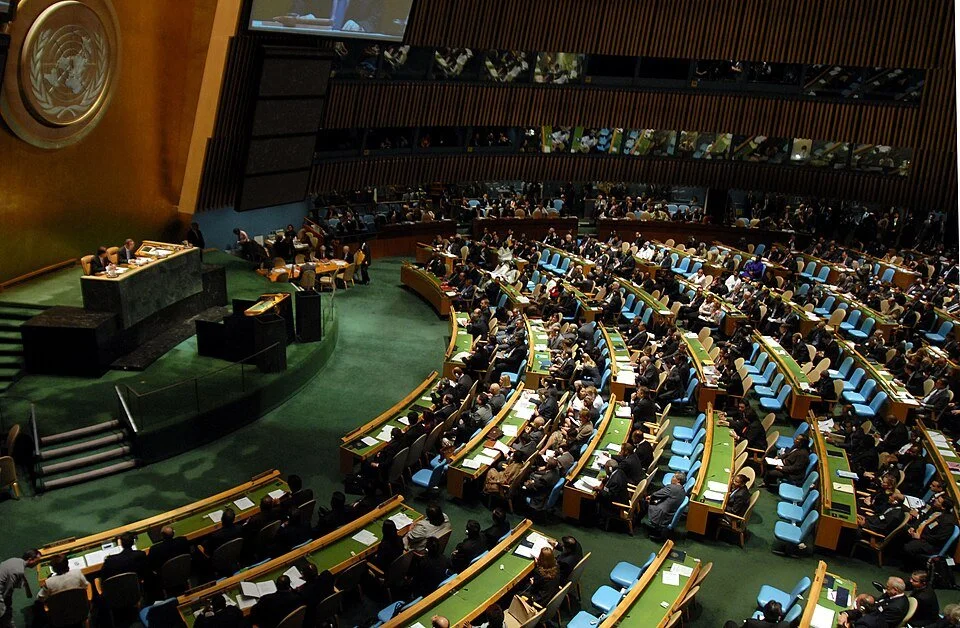
Marcello Casal JR/ABr, CC BY 3.0 BR <https://creativecommons.org/licenses/by/3.0/br/deed.en>, via Wikimedia Commons
UN member states meet at the General Assembly to discuss global environmental issues.
The resolution urges governments to coordinate in order to tackle climate change on a global scale and ensure that climate policies provide everyone with a right to a decent standard of health and living. As Tasneem Essop, who is the Executive Director for Climate Action Network International, stated, “The challenge now is transforming legal obligations into real action consistent with Equity, Common But Differentiated Responsibilities and Respective Capabilities, and the protection of human rights.”
It is a big step forward for the more undeveloped countries. The resolution was proposed by Vanuatu - a small island archipelago in the South Pacific - who are more vulnerable to the effects of climate change such as rising sea levels. Ralph Regenvanu, Vanuatu's Minister of Climate Change, said, “In the current geopolitical context, sustained commitment to the rule of law is more important than ever” and climate change “is no exception.”
The undeveloped countries are often the ones most exposed to the changes that climate change brings such as storms, high seas or drought. Odo Tevi, Vanuatu's Ambassador to the UN, stated that, “We should be honest with one another about why this matters … It matters because the harm is real and it is already here, along our islands and coastlines, for communities facing drought and failed harvests. The states and peoples bearing the heaviest burden are very often those who contributed least to the problem.”

Sheminghui.WU, CC BY-SA 4.0 <https://creativecommons.org/licenses/by-sa/4.0>, via Wikimedia Commons
Vanuatu coastline
António Guterres, the UN Secretary-General, saw hope in that the future of climate justice “runs through a rapid, just, and equitable transition away from fossil fuels towards renewable energy.” He also stated that renewables are the most secure and cheapest option to keep the global temperature rise below 1.5 degrees above pre-industrial levels and that this target was still achievable.
Tasneem Essop (CAN) added, “Without doubt, this vote is an important and historic political signal that governments are prepared to respond to the legal clarity that the ICJAO (The International Court of Justice Advisory Opinion) provided. It also means that major emitters, and particularly historic emitters, can no longer ignore the world's highest court when it comes to the harms caused by climate change.”
The resolution follows on from a ruling in 2025 from the International Court of Justice (ICJ) which set out the proposal to make the more polluting countries responsible for their impact on climate change but gives more power to any rulings. The resolution provides a legal and moral authority to help ensure that if States breach the obligations, that they are legally bound to not only stop the breach but also make full reparation and that tackling the climate crisis is a legal duty under international law. Anne Jellema, the Executive Director of 350.org, said: “This resolution marks a turning point, a clear affirmation that governments are not only morally bound, but legally responsible for protecting people from climate harm. …. The task now is simple: turn this legal recognition into urgent, real-world action that delivers justice for those most affected.
Mr Guterres described the initial ICJ ruling as “a victory for our planet”. After the UN General Assembly vote, he celebrated the result as “a powerful affirmation of international law, climate justice, science and the responsibility of states to protect people from the escalating climate crisis”
Eight states voted against it and these include some of the biggest oil producers - US, Saudi Arabia, Russia, Belarus, Iran, Israel, Yemen and Liberia. Twenty-eight other states abstained. Tammy Bruce, the US Deputy Ambassador to the UN, called the climate resolution “highly problematic” and complained that, “The resolution includes inappropriate political demands relating to fossil fuels”.